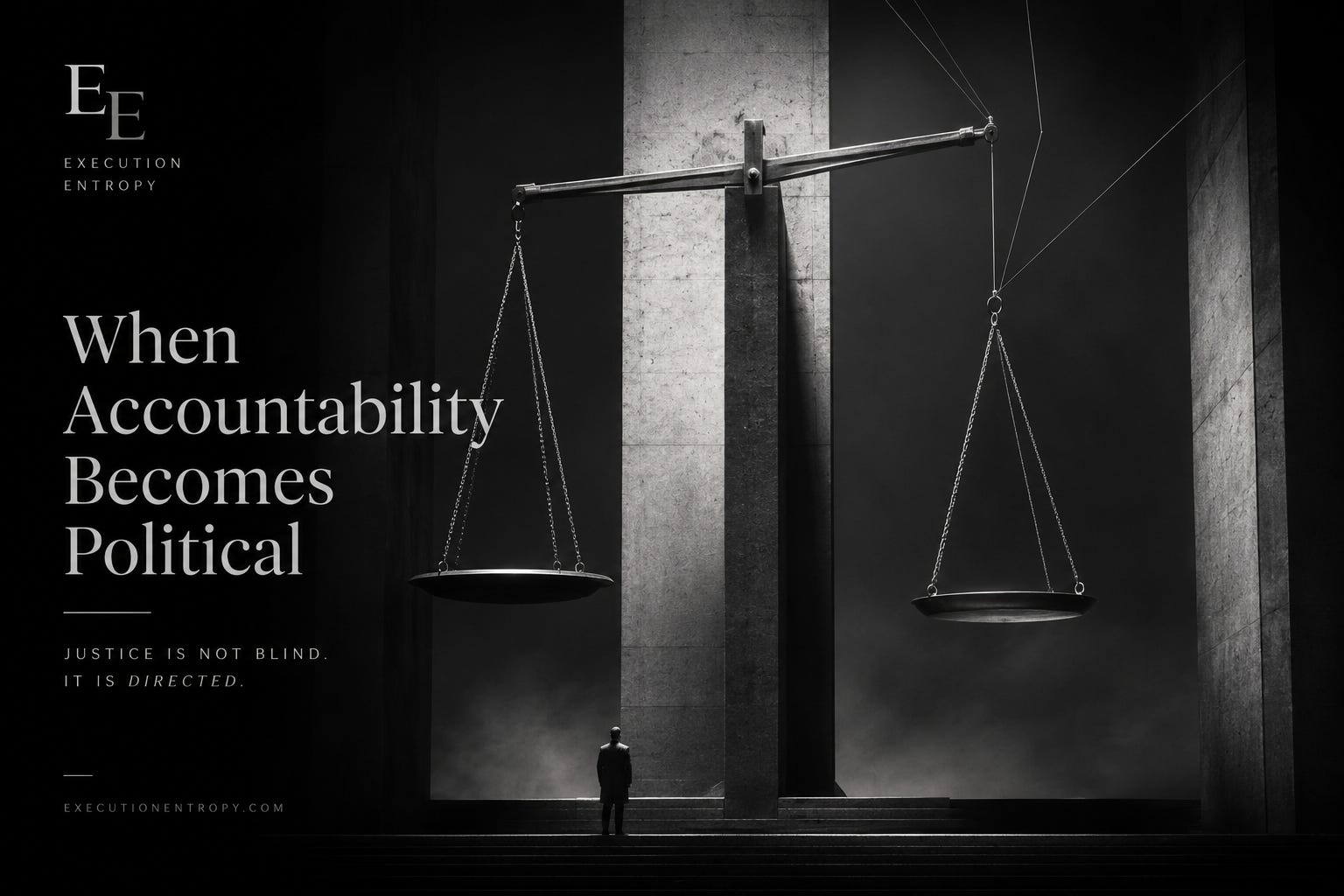
When Accountability Becomes Political
Why standards collapse when consequences depend on who made the mistake.

Most organizations claim to value accountability.
Far fewer apply it consistently.
This distinction matters more than leaders often realize.
Employees do not judge accountability by policy documents.
They judge it by observation.
They watch what happens after mistakes occur.
Who gets questioned.
Who gets protected.
Who receives consequences.
Who receives explanations.
Over time they learn whether accountability is real or performative.
The moment accountability becomes dependent on status, relationships, politics, or perception, it stops functioning as a standard.
It becomes a negotiation.
And once accountability becomes negotiable, organizational decline accelerates.
⸻
Accountability Is Supposed To Reduce Uncertainty
Healthy accountability systems create clarity.
People understand expectations.
People understand ownership.
People understand consequences.
The goal is not punishment.
The goal is predictability.
Employees should know that performance standards apply consistently regardless of title or influence.
That consistency creates trust.
Without trust, execution becomes increasingly difficult.
Because people stop focusing on the work.
They start focusing on survival.
⸻
Selective Accountability Changes Behavior
Employees adapt to incentives.
Not values statements.
If one employee misses a deadline and receives scrutiny while another misses the same deadline and receives protection, employees learn something important.
The organization is not measuring performance.
It is measuring politics.
From that moment forward behavior begins changing.
People become more concerned with perception.
More concerned with relationships.
More concerned with visibility.
Less concerned with outcomes.
The system quietly teaches employees that influence matters more than execution.
⸻
The Rise Of Political Performance
When accountability becomes political, performance becomes political as well.
Employees quickly recognize that certain individuals operate under different rules.
Some people are evaluated based on results.
Others are evaluated based on relationships.
The difference creates resentment.
Not because employees expect perfection.
Because they expect fairness.
People can tolerate difficult expectations.
They struggle to tolerate unequal expectations.
The result is predictable.
Trust declines.
Engagement weakens.
Cynicism expands.
⸻
Why Leaders Allow It
Few leaders intentionally create political accountability systems.
Most drift into them.
A difficult conversation gets avoided.
A favored employee receives another exception.
A senior contributor becomes untouchable.
A manager protects a poor decision.
Individually these choices feel small.
Collectively they redefine the culture.
The organization slowly learns that consequences are determined by context rather than conduct.
Once that lesson spreads, accountability loses credibility.
⸻
High Performers Notice Immediately
Competent employees usually identify selective accountability long before leadership does.
They experience the consequences directly.
They watch standards enforced aggressively in some situations and ignored entirely in others.
Eventually they stop asking:
“Did the mistake happen?”
And start asking:
“Who made the mistake?”
That shift is devastating.
Because once identity matters more than behavior, standards stop being standards.
They become political tools.
⸻
When Trust Collapses
Most organizations believe trust is built through communication.
In reality trust is built through consistency.
Employees trust systems that behave predictably.
They distrust systems that apply rules selectively.
The damage often remains invisible for months.
Meetings continue.
Projects continue.
Reports continue.
The organization appears stable.
Underneath the surface people begin withdrawing.
They stop escalating concerns.
They stop volunteering uncomfortable truths.
They stop believing fairness exists.
The culture becomes increasingly performative because reality no longer feels safe.
⸻
Final Thought
Accountability is not tested when it is easy.
It is tested when applying it becomes uncomfortable.
Every organization eventually faces moments where protecting relationships conflicts with protecting standards.
Those decisions shape culture more than any mission statement ever will.
Because employees remember who was held accountable.
They also remember who was not.
And once accountability becomes political, standards begin collapsing one exception at a time.
Organizations rarely fail because they lack rules.
They fail because employees stop believing the rules are real.
⸻
If this made you think of a specific situation, forward it to someone who needs to read it.
And if you want the next article when it drops, subscribe below. I currently only send these out on Tuesdays.