When Organizations Lose The Ability To Self-Correct
The most dangerous stage of decline begins when honest feedback becomes riskier than silence.

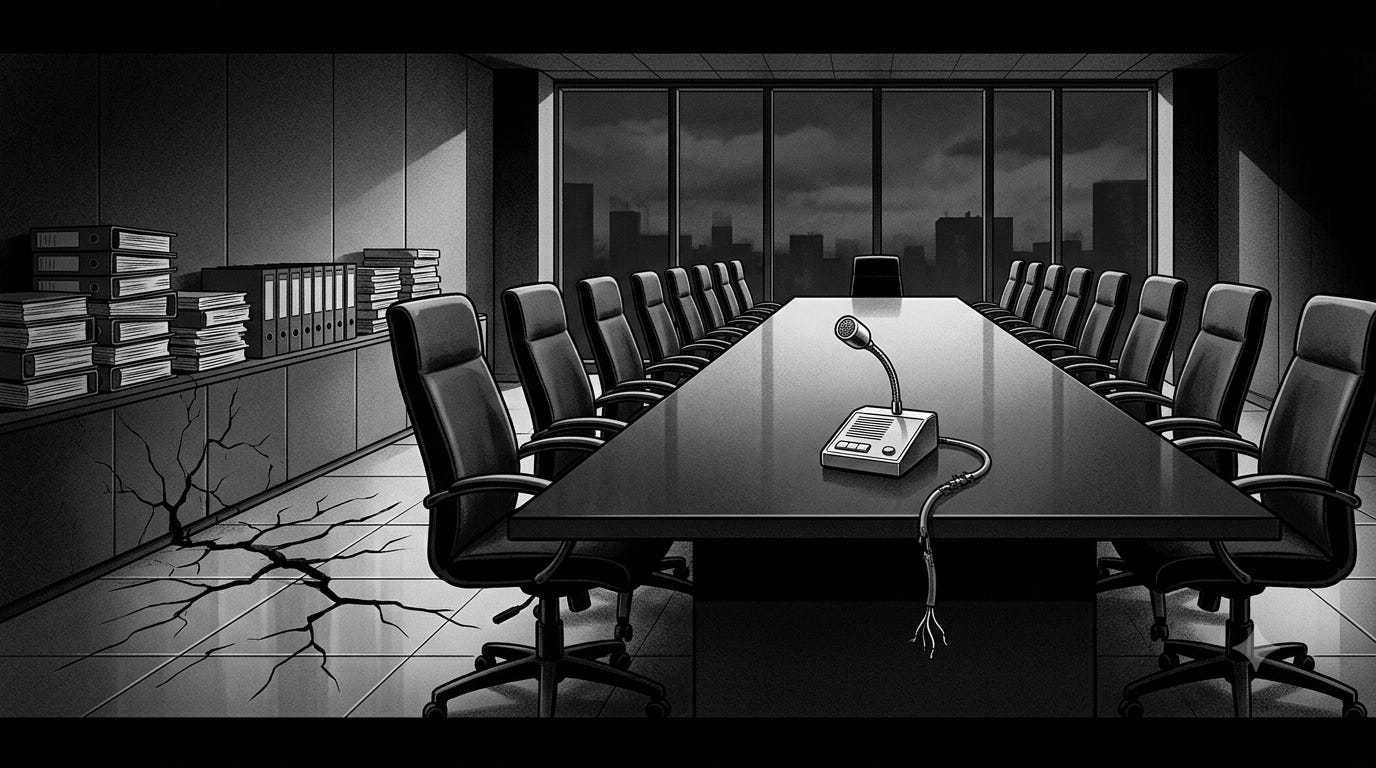
Most organizations do not fail the moment problems appear.
They fail when problems can no longer be corrected.
That stage arrives earlier than most leaders realize.
Long before a public miss.
Long before major turnover.
Long before obvious financial damage.
The real danger begins when the organization loses its internal ability to tell itself the truth.
That is the moment self-correction starts dying.
And once self-correction weakens, decline becomes cumulative.
Not because nobody sees the problem.
Because fewer people are willing to say it clearly.
⸻
Every Healthy Organization Depends On Internal Friction
Strong organizations are not healthy because they avoid tension.
They are healthy because useful tension survives inside the system.
People can challenge bad assumptions.
People can raise concerns early.
People can identify weak decisions without being treated as disloyal.
People can name reality before the consequences become expensive.
This kind of friction is operationally necessary.
It is part of how institutions stay functional.
Without it, errors compound quietly.
Weak hires remain in place.
Bad process expands.
Poor decisions repeat.
Standards erode without resistance.
A healthy organization does not need unanimous agreement.
It needs enough honesty to interrupt drift.
That is what self-correction actually is.
Not perfection.
Not constant change.
Just the preserved ability to respond truthfully to reality.
⸻
The Shift Usually Starts Small
Organizations rarely announce that honesty has become dangerous.
The transition is subtle.
A concern gets dismissed because the timing is inconvenient.
A manager punishes the tone instead of addressing the issue.
A politically protected employee becomes too risky to evaluate honestly.
A project continues because stopping it would embarrass the wrong person.
A team learns that bad news requires emotional management before operational response.
None of this looks catastrophic in isolation.
That is why it spreads.
Employees adapt.
They learn which truths are welcome.
They learn which facts need softer language.
They learn which problems can be raised safely and which ones should stay unspoken.
This is how institutional dishonesty grows.
Not only through direct lies.
Through selective honesty.
Through managed clarity.
Through the gradual conversion of truth into a political object.
⸻
Leadership Often Misreads The Early Warning
One of the most dangerous features of accountability collapse is that it can feel calm from above.
Open disagreement decreases.
Escalations slow down.
Meetings become more polished.
Fewer people challenge official narratives.
Leaders often read this as alignment.
Usually it means the system is getting quieter for the wrong reason.
People are not speaking less because the organization improved.
They are speaking less because they have updated their risk calculation.
They no longer believe candor produces correction.
They believe candor produces exposure.
That change matters.
The organization may still have intelligent employees.
It may still have capable managers.
It may still have strong intentions.
But once employees start filtering reality for self-protection, the institution begins losing access to its own internal intelligence.
At that point, leadership is operating on increasingly distorted information.
And distorted information produces distorted decisions.
⸻
High Performers Usually Notice This First
High performers tend to recognize self-correction failure earlier because they interact with operational reality more directly.
They see the same unresolved problems returning.
They see weak contributors protected.
They see meetings replacing decisions.
They see leaders asking for honesty and then rewarding comfort.
Most importantly, they notice when speaking clearly changes nothing.
Or makes things worse.
This is a major psychological break.
Competent employees can tolerate hard work.
They can tolerate pressure.
They can tolerate difficult goals and imperfect environments.
What they struggle to tolerate is futility with awareness.
The exhausting part is not merely that the problem exists.
It is knowing the problem is visible, explainable, and still protected.
That is where moral exhaustion deepens.
Not just because the system is broken.
Because the system is teaching people not to repair it.
⸻
Silence Is Not Neutral
Once honest feedback becomes risky, silence starts looking rational.
That rational silence has consequences far beyond morale.
It changes who advances.
It changes what gets discussed.
It changes what becomes legible to leadership.
People who can manage perception start outperforming people who surface reality.
Comfort becomes a professional skill.
Candor becomes a liability.
From there, political behavior expands naturally.
Not because everyone suddenly becomes manipulative.
Because the incentive structure has changed.
If truth creates risk and appearances create safety, employees adapt accordingly.
Soon the organization has fewer accurate conversations.
Then fewer accurate decisions.
Then fewer accurate narratives about why performance is slipping.
This is one reason decline often looks confusing in late stages.
Leadership experiences execution problems without fully understanding that the diagnostic system failed first.
The organization did not merely stop executing well.
It stopped being able to interpret itself honestly.
⸻
The Internal Immune System Breaks Down
Every functioning organization has some version of an immune system.
Not a formal one.
A behavioral one.
People notice inconsistency.
People question weak logic.
People resist standards drift.
People surface early signs of damage.
This is how institutions protect themselves from accumulated error.
When that system works, dysfunction triggers response.
When it fails, dysfunction becomes normalized.
That normalization is dangerous.
Once recurring failures produce no real correction, employees stop seeing them as exceptions.
They start treating them as environmental facts.
At that stage, adaptation replaces resistance.
Teams build workarounds around poor performers.
Managers design process around avoidable incompetence.
Reliable employees carry hidden cleanup work as part of normal operations.
Meetings multiply to compensate for disappearing ownership.
Documentation expands because trust shrinks.
None of this restores health.
It only helps the organization function while decay continues underneath.
This is why organizational decline can remain invisible for so long.
The system keeps absorbing damage.
Until the people absorbing it start leaving.
⸻
Why Leaders Protect The Conditions That Harm Them
Weak leaders do not usually intend to destroy self-correction.
They often do it while trying to protect stability.
They avoid embarrassing conversations.
They soften accountability.
They defend bad hires.
They interpret discomfort as dysfunction.
They overvalue harmony because conflict threatens their authority or self-image.
This creates a dangerous pattern.
Leadership begins treating the people who surface reality as the source of instability.
Meanwhile the actual instability remains untouched.
Over time, the message becomes unmistakable.
The problem is not poor execution.
The problem is making poor execution visible.
That lesson travels quickly through an organization.
Once it does, the culture changes underneath leadership.
People stop asking what is true.
They start asking what is safe.
That is one of the clearest signals that execution entropy has entered a more advanced stage.
⸻
This Is How Standards Collapse Without Announcement
Standards rarely disappear through formal decision.
They disappear through unrepaired contradiction.
Leadership says quality matters.
But weak work survives.
Leadership says accountability matters.
But consequences remain selective.
Leadership says feedback is welcome.
But honesty keeps creating risk.
Eventually employees stop listening to stated values.
They watch operating reality instead.
That is where culture is actually defined.
Not in official expectations.
In repeated observations about what the system protects.
If the organization protects comfort over correction, standards become symbolic.
If it protects appearances over truth, accountability becomes performative.
If it protects status over accuracy, self-correction disappears.
The institution may still use the language of excellence.
But the language no longer governs behavior.
And once the language detaches from reality, institutional dishonesty hardens.
⸻
The Cost Arrives Later
One reason leaders miss this stage is that self-correction failure does not always create immediate collapse.
In the short term, it can even create smoother optics.
Less conflict.
Cleaner meetings.
More disciplined messaging.
More visible alignment.
That temporary calm is misleading.
The cost arrives later.
Problems age inside the system.
Weak people become entrenched.
Competent people become quiet.
Then tired.
Then gone.
At some point the organization faces a problem large enough that performance theater cannot cover it.
By then, the capacity for honest response is already damaged.
The people who might have named the issue early have been ignored, sidelined, or exhausted into silence.
Leadership then experiences failure as sudden.
It rarely was.
The institution was warning itself for a long time.
It simply stopped listening to the people still capable of hearing it.
⸻
Final Thought
Organizations do not become incapable of self-correction overnight.
They become incapable one suppressed truth at a time.
One protected underperformer at a time.
One politically managed problem at a time.
One punished act of honesty at a time.
That is how execution entropy deepens.
Not only through bad decisions.
Through the steady destruction of the conditions required to recognize and repair bad decisions.
A healthy organization is not one that avoids mistakes.
It is one where reality can still reach power.
Once that path closes, decline stops being a performance problem.
It becomes an institutional condition.
And by the time the failure is visible from the outside, the ability to correct it has often already disappeared inside.
⸻
If this made you think of a specific situation, forward it to someone who needs to read it.
And if you want the next article when it drops, subscribe below. I currently only send these out on Tuesdays.